
Today's Hours:


Cicadas: What is up with that sound?
2 minutes
May 24, 2022
Around this time of the year, the woods of River Legacy start producing a very peculiar sound. It is loud and generally described as a high-pitched buzzing sound. The origin of this sound is one of the most intriguing and well-known inhabitants of River Legacy: the cicada. It is quite likely that you have heard this sound before. It forms an integral part of the summer experience in North America. Let’s delve more into cicadas and the sound they produce.
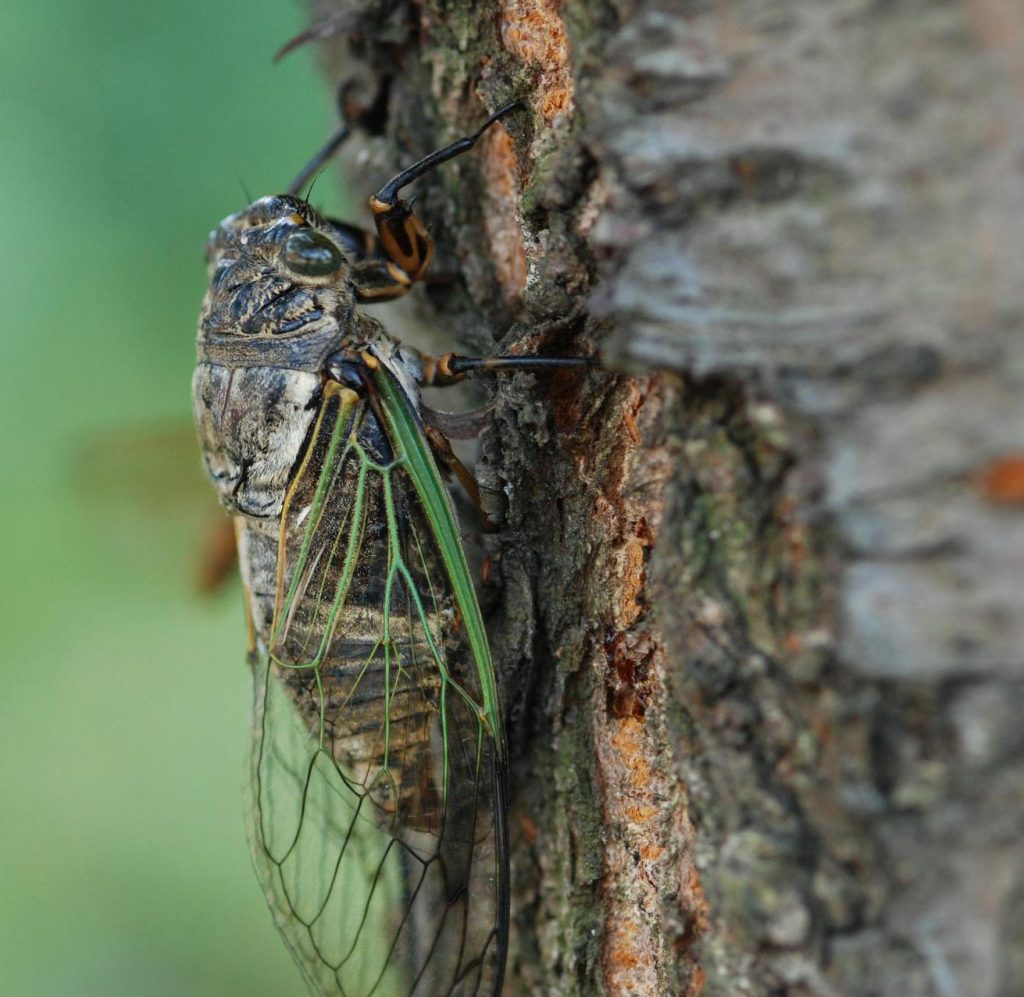
Cicadas are insects that belong to the order Hemiptera, a very big and diverse order of insects known collectively as the “true bugs and relatives.” This makes cicadas distant relatives to insects such as aphids, stink bugs, shield bugs, leafhoppers, and bed bugs–yes, those bed bugs! There are roughly 3,000 species of cicadas and they inhabit every continent except Antarctica. In North America, there are about 200 species of cicadas. The most common species of cicadas belong to the genera Tibicen, Megatibicen, Hadoa, and Diceroprocta and are known as the dog-day cicadas. These are considered to be annual cicadas.
This means that they have a life cycle that lasts anywhere from 2 to 5 years, in general. On the other hand, species belonging to the genus Magicicada are known as the periodic cicadas, because their life cycle is very different from the others. These cicadas have either a 13-year or 17-year life cycle, so broods can remain underground for years until it is time for them to emerge. The vast majority of these cicadas can be found east of the Mississippi River. Most of the cicadas in Texas are annual cicadas though there are some members of Magicicada found in counties along the Red River, bordering Oklahoma.
The cicada sound is essentially a mating call produced by the males in order to attract a female cicada. The sound can also be used to announce an individual’s territory. The origin of this sound can be traced back to a special organ that few insects have: the tymbal organ. The male cicadas possess 2 of these, which are circle-shaped ridged membranes found on the back and side of the 1st abdominal segment of the cicada. The muscle that attaches to the tymbals contracts and bends the tymbals, which creates a clicking sound. When the muscle relaxes, they go back to their previous form. The tymbals contract so frequently (120 to 480 times a second) that it appears as a long, continuous sound to the human ear. There are air sacs in Cicadas that amplify the sound to produce the iconic cicada buzzing sound!
Cicadas are very special insects with an amazing adaptation that has made them world famous. As you take a walk through the River Legacy this summer, remember how the cicada sounds are being made as they graciously cover the woods.
Sources:
- Bauer, Patricia. “Why are cicadas so noisy?”. Encyclopedia Britannica, Invalid Date, https://www.britannica.com/story/why-are-cicadas-so-noisy. Accessed 9 May 2022.
- Evans, Arthur. Field Guide to Insects and Spiders of North America. 1st ed., New York, Sterling Publishing Company, 2008.
- Abbott, John, and Kendra Abbott. Common Insects of Texas and Surrounding States: A Field Guide. 1st ed., Austin, University of Texas Press, 2020.
- Drees, Bastiaan, and John Jackman. A Field Guide to Common Texas Insects. 1st ed., Houston, Gulf Publishing Company, 1998.
- Liebhold, A. M., Bohne, M. J., and R. L. Lilja. 2013. Active Periodical Cicada Broods of the United States. USDA Forest Service Northern Research Station, Northeastern Area State and Private Forestry.
Upcoming Events

October 17, 2026
Saturday Morning Hike
Join a River Legacy naturalist for a free Saturday morning hike through the trails of River Legacy Park! Enjoy a relaxed walk while learning more...
Learn More

October 21, 2026
The River that Made Texas: An Evening with Scot McFarlane
Join River Legacy Nature Center for a special evening with river historian and author Scot McFarlane, celebrating the release of his new book, The River...
Learn More

October 22, 2026
Adventures with Skunks (2.5-4 yrs old)
Join us to learn all about skunks! This is a 1 1/2 hour learning opportunity for preschoolers (ages 2 1/2 to 4 years old) and...
Learn More

October 26, 2026
Pumpkinology Enrichment Class (Ages 5-9)
In this hands-on science class, students will explore pumpkins inside and out! We’ll dissect a pumpkin to examine its parts, test whether it sinks or...
Learn More

October 31, 2026
Free Animal Presentation: Sonoran Gopher Snake
Join us for Creature Features and meet River Legacy Nature Center’s featured animal ambassador: the Sonoran gopher snake! Learn about the animal’s adaptations, behavior, lifestyle...
Learn More
November 2, 2026
Insect Inn Enrichment Class (Ages 5-9)
Welcome to the Insect Inn, where young nature explorers become builders and bug buddies! In this hands-on STEM class, children will create their very own...
Learn More
November 5, 2026
Adventures with Bats (2.5-4 yrs old)
Join us to learn about the wonderful life of bats! This is a 1 1/2 hour learning opportunity for preschoolers (ages 2 1/2 to 4...
Learn More

November 6, 2026
A Night with Nature
Join us for A Night With Nature—an enchanting evening of food, drinks, and fun at River Legacy Nature Center! This 21 fundraiser supports our vital environmental...
Learn More

November 19, 2026
Adventures with Woodpeckers (2.5-4 yrs old)
Join us to learn all about woodpeckers! This is a 1 1/2 hour learning opportunity for preschoolers (ages 2 1/2 to 4 years old) and...
Learn More

November 23, 2026
Nature’s Simple Machine Enrichment Class (Ages 5-9)
In this hands-on class, young explorers will discover how simple machines can be found in nature and how animals use these clever tools to help...
Learn More